A SCENARIO FORECAST IN TWO ENDINGS

Compute 2030

The substrate takeoff, told forward, threshold by threshold, with two endings.

Compute 2030 - Road A and Road B scenario fork at the 2030 crossoverA line chart showing the direct Configuration Tax from 2025 to 2040. A single trunk begins at a 57.3% within-architecture configuration gap in 2025 and reaches a fork node at the 2030 crossover. Road A continues downward in green; Road B preserves the gap for non-owner fleets in crimson. The chart does not measure cross-class mismatch.202520262027-2820302040ROAD AOwned by no oneROAD BOwned by one57.3% CONFIGURATION TAXCROSSOVER
2025
2026
2027-28
2030
Road A
Road B
ROAD AHeterogeneous Equilibrium - signed verification regime
ROAD BSubstrate Capture - owned by one

We predict that the impact of general intelligence for silicon over the next decade will be enormous, exceeding that of the semiconductor revolution itself.

Published 2026|PDF|Coming soon|Coming soon

We wrote a scenario that represents our best guess about what that might look like. It is informed by hardware roadmap extrapolations, fleet utilization data, wargames run with sovereign and hyperscaler customers, expert interviews with compiler engineers and chip architects, and previous forecasting work on the general intelligence for silicon stack.1Informed by hardware roadmap extrapolations, fleet utilization data, wargames run with sovereign and hyperscaler customers, expert interviews with compiler engineers and chip architects, and previous forecasting work on the general intelligence for silicon stack. [primary research / expert interviews]

We have tried to be concrete and quantitative, which means depicting one of many possible futures rather than hedging across all of them. We will not be right about everything. Some of the dates will slip, some of the thresholds will arrive in a different order, and the named events are illustrative rather than load-bearing. What we are confident in is the shape, because the forces are already in motion, the first measurements are already in, and the window is already closing.

This is a forecast with a spine of measurement, which is what we think distinguishes it from speculation about the future of intelligence. The central quantity is not a guess; it is a number, taken on instruments, with a confidence interval. The architecture explosion is not a metaphor; it is a count, climbing on a curve driven by costs that are already collapsing. The labor wall is not a fear; it is a growth rate, six percent a year, set against an exponent that is steeper. Our confidence lives in those measured anchors, and our humility lives everywhere the anchors run out, which is why the dates in what follows are pegs accurate to within a window and the mechanisms are the actual claim.

The argument is simple to state. The variety of silicon is about to outrun the human capacity to make it usable. The gap between what the world's compute can do and what it actually delivers is already measured at 57.3 percent.2Configuration Tax: 57.3 percent, 95% CI [55.1, 59.4]. Measured on a controlled testbed of heterogeneous production accelerators, eight campaigns, ninety-two days, 847 configuration-workload pairings per architecture. [measured] That gap will widen as the architecture count climbs, until something is built that can absorb the variety with no human in the loop. That something is a model of how all silicon behaves - general intelligence for silicon - and whoever builds it will not be selling software. They will be writing the rules for how the world's compute is governed.

The reason the answer has to be a model, and not a better tool, is older than the crisis it solves. A theorem from the cybernetics of the last century holds that every good regulator of a system must contain a model of that system: you cannot reliably control what you have not, in some formal sense, modeled. If the system to be regulated is the behavior of all silicon, then the regulator must be a model of how all silicon behaves. Not a faster scheduler, not a cleverer autotuner, both of which have been tried and both of which fall further behind as the variety grows, but a learned model of the physics underneath the chips. That is what general intelligence for silicon is, and why the thing that finally absorbs the variety is an intelligence rather than an optimization.

We wrote two endings, because the same shift can arrive two ways. In one, the layer that absorbs the variety is neutral, open, and owned by no one. In the other, it is captured - by a single company or a single state - before anyone decides that it should not be. The difference between the two is not the technology, which arrives either way. The difference is whether anyone acts inside the window. This is not a recommendation and not an exhortation. It is a forecast, and we hope to be argued with.3The two endings are not a recommendation. The difference between them is not the technology, which arrives either way. The difference is whether anyone acts inside the window. [thesis]

Notes
  1. 1Informed by hardware roadmap extrapolations, fleet utilization data, wargames run with sovereign and hyperscaler customers, expert interviews with compiler engineers and chip architects, and previous forecasting work on the general intelligence for silicon stack. [primary research / expert interviews]
  2. 2Configuration Tax: 57.3 percent, 95% CI [55.1, 59.4]. Measured on a controlled testbed of heterogeneous production accelerators, eight campaigns, ninety-two days, 847 configuration-workload pairings per architecture. [measured]
  3. 3The two endings are not a recommendation. The difference between them is not the technology, which arrives either way. The difference is whether anyone acts inside the window. [thesis]
Part IThe Crisis and the Closing Loop

2025 to the branch point, 2028

2025THE MEASURED CRISIS
FLEET COORDINATION
MANUALAUTONOMOUS
Manual
CAPABILITIES
⬡PRF
◈SIM
⊞PAR
⊛CTL
⊕GEN
◉AUT
SUBSTRATE OWNERSHIP
NVIDIA / CUDA 90%
Other merchant 10%
LABOR VS VARIETY
~8,000 specialists / ~50 architectures
SUBSTRATE
Configuration Tax57.3%
Utilization<30%
Coverage0%
Value$0
WORLD
Strandedaccruing
Capex~$500B/yr
GovernanceABSENT
Crossoverest. 2032
CONFIGURATION TAX TRAJECTORY
The crisis is measured, enormous, and entirely unaddressed.

The Measured Crisis

The machines are running, and almost no one has measured how badly. The waste is invisible because it is distributed: a few points here, a few points there, eight thousand exhausted specialists each losing a Monday.

It is 2:17 in the morning in Osaka, and Priya is on her 847th configuration. The chip on her bench is a dataflow accelerator from a Taiwanese fabless startup, twelve weeks out of the fab, in no public benchmark and no compiler toolchain that knows it exists. Her job is to make it run her customer's inference workload by Monday. She types a number into a configuration file and waits for the workload to compile and run. The monitor reads thirty-four percent of the chip's rated throughput. She changes a tiling parameter. Forty-one. She changes the memory layout. Thirty-eight. The chip is capable of eighty percent on this workload and she knows it, and the gap is not a mystery to her; it is the cost of a part whose behavior no one has yet encoded into the tools she is using, and that encoding is weeks of work she does not have. At 2:31 she commits the number that gave her forty-one and goes to bed. The chip will run at forty-one until someone has the time to do it properly, which is to say, in the experience of everyone in this profession, never.

Priya's profession does not have a clean name. The people in it are called performance engineers, or kernel engineers, or compute architects, or, in the job postings that cannot quite describe what they do, heterogeneous systems specialists. What they share is a rare and slow-built skill: the ability to take a piece of silicon whose behavior is documented badly or not at all and coax a workload onto it at something near its potential. There are, on the most generous estimate, about eight thousand of them on Earth who can do this for a genuinely new architecture, and that number is the binding constraint on everything that follows.4Binding-constraint specialist pool ~8,000 (2025); this is the count who can integrate a genuinely new architecture by hand, not the broader pool of kernel engineers for dominant-vendor chips. [internal estimate] It is not the count of people who can write a kernel for the dominant vendor's chips, which is large and growing. It is the count who can do it for a chip the dominant vendor's tools have never seen, which is small, slow to grow, and about to be asked to do something impossible.

The gap between forty-one and eighty is not an anecdote, and in 2025 it gets measured properly for the first time. The measurement is deliberately unglamorous: a controlled testbed of heterogeneous production accelerators, the same workloads run on each, the default vendor configuration compared against the best a team of experts can reach given effectively unlimited time. Eight campaigns, ninety-two days, 847 configuration-workload pairings per architecture.5Measurement protocol: controlled testbed of heterogeneous production accelerators, eight campaigns, ninety-two days, 847 configuration-workload pairings per architecture. The median gap is 57.3 percent, 95% CI [55.1, 59.4], right-skewed. [measured] The median gap between default and expert-tuned throughput is 57.3 percent, with a 95 percent confidence interval of 55.1 to 59.4, and the distribution is right-skewed, which means the median understates the worst cases, the newest and strangest silicon where the gap yawns widest. The report names it the Configuration Tax: the directly measured, within-architecture gap between default and expert-tuned configuration on the same chip and workload.

The direct Configuration Tax is one layer of a deeper waste, and the two should never be confused. The 57.3 percent is the within-architecture gap between default and optimal configuration on a given chip and workload. Cross-class mismatch is a separate, currently unmeasured category. Kernel inefficiency, cluster fragmentation, and temporal idleness are separate losses again; together, they are not the Configuration Tax.6Production AI fleet utilization below 30 percent of theoretical peak, consistent across published cluster studies. The 57.3 percent substrate-mismatch component and the sub-30-percent total fleet utilization are distinct measurements of distinct losses. [verified-secondary] The two figures, the measured 57.3 percent and the broader sub-third utilization, are different measurements of different things, and the report keeps them apart on every page.

This is happening at the center of the largest capital mobilization in the history of technology. Hundreds of billions of dollars a year, rising toward a cumulative five trillion by 2030, are being pointed at compute hardware that runs at a fraction of its rated capability.7Cumulative AI data-center capex approaching $5 trillion by 2030 on widely cited estimates; annual capex running to hundreds of billions. [verified-secondary] The waste is invisible precisely because it is so widely distributed and so quietly absorbed. Consider the arithmetic from inside a data-center operator: a GPU depreciates whether or not it is used, and whether or not it is used well. A fleet running at thirty percent of potential is a fleet on which two-thirds of the most expensive line item on the balance sheet is evaporating, on schedule, into heat and idle cycles. No operator reports this, because reporting it would mean publishing the fact that the assets the market values them on are idling, and the market has not yet learned to ask.8No operator reports fleet utilization shortfalls because doing so would mean publishing the fact that the assets the market values them on are idling. [thesis / observation] It is eight thousand Priyas, each losing a Monday, summed across an industry and rounded off as a cost of doing business.

The obvious objection, in 2025, is that this is what compilers and autotuners are for, and that the gap will close on its own as the tooling matures. It will not, and the reason is the shape of the problem. An autotuner searches the configuration space of one chip running one workload; it is a per-chip, per-workload effort that yields an answer good until the chip or the workload changes, at which point the search begins again from nothing.9An autotuner is a per-chip, per-workload search; it yields an answer good until the chip or workload changes, at which point the search begins again from nothing. It does not generalize. [thesis] It does not generalize, because it learns nothing transferable; it is a flashlight, not a map. And the thing the autotuner is racing is not standing still. The number of chips is about to explode, and a method that must restart its search for every new chip falls further behind the faster the world moves. The tooling is not the answer. The tooling is the thing the answer has to replace.

The reason the waste does not simply get fixed is that fixing it is human work, and the humans do not scale. The specialist pool grows at roughly six percent a year, the historical rate of an adjacent technical discipline, and it cannot be accelerated with money, because it takes three to five years to train one of these people and the pipeline is fixed.10Specialist pool grows at ~6 percent per year, the historical rate of an adjacent technical discipline; inelastic to capital because the constraint is training time (3-5 years per specialist), not wages. [internal estimate] For seventy years this did not matter, because the number of architectures that mattered was small and stable, anchored by one dominant instruction set and one dominant accelerator vendor. The whole industry made an implicit bet, so deep it was never stated aloud: that hardware diversity is bounded, and that human expertise scales with it. Both halves of that bet are about to come due at once, and the report's central claim is that they come due on a schedule, not a maybe.

And in a small number of research groups, a different idea is taking shape, drawn from an old theorem. In 1970 two cyberneticists proved the Good Regulator Theorem - that every good regulator of a system must contain a model of that system; you cannot reliably control what you have not, in some formal sense, modeled.11Conant-Ashby theorem (1970): every good regulator of a system must contain a model of that system. The corollary for compute: the regulator of all silicon must be a model of how all silicon behaves. [verified-secondary] The corollary, in 2025, is uncomfortable and clarifying: if the system to be regulated is the behavior of all silicon, then the regulator must be a model of how all silicon behaves. Not a faster autotuner, not a better heuristic, but a learned model of the physics underneath the chips, the thing the autotuner conspicuously is not. One such group has a forty-seven-billion-parameter graph neural network in training, fed on the execution traces of hundreds of distinct processors, learning to predict how a chip it is shown will behave on a workload it is given.12HPM-1: the Hardware Performance Model, trained on execution traces of hundreds of distinct processors. CWM-1 is the Compute World Model that uses those profiles to rehearse fleet behavior. In 2025 the stack is a research artifact. [internal / primary research] They call the hardware-performance profiler HPM-1. Its outputs feed CWM-1, the Compute World Model used to rehearse fleet behavior. In 2025 the stack is a research artifact. It does not work yet, and most of the industry has never heard of it.

The markets, in 2025, are not interested. They are pricing the chip makers, the model labs, and the data-center builders, and the layer that makes the chips usable is not yet a category anyone trades. The government is not interested either; its attention is on who manufactures the silicon and who is allowed to buy it, a contest fought one layer below the one that will come to matter. The crisis is measured, enormous, and entirely unaddressed, which is the condition from which every other chapter in this report departs.
Architecture count vs specialist pool, 2025-2030A dual-axis line chart comparing AI architecture count (rising from 50 in 2025 to over 1,000 in 2030) against the specialist pool (growing modestly from 8,000 to 10,700). The widening gap defines the labor burden behind fleet coordination. It is not a measurement of the direct Configuration Tax or of cross-class mismatch.CROSSOVER202520262027202820292030ARCHITECTURESArchitecture countSpecialist pool (6%/yr)
Architecture count vs specialist pool, 2025-2030. The crossover - where manual fleet coordination fails industry-wide - is estimated at 2030 ± 2 years.
Notes
  1. 4Binding-constraint specialist pool ~8,000 (2025); this is the count who can integrate a genuinely new architecture by hand, not the broader pool of kernel engineers for dominant-vendor chips. [internal estimate]
  2. 5Measurement protocol: controlled testbed of heterogeneous production accelerators, eight campaigns, ninety-two days, 847 configuration-workload pairings per architecture. The median gap is 57.3 percent, 95% CI [55.1, 59.4], right-skewed. [measured]
  3. 6Production AI fleet utilization below 30 percent of theoretical peak, consistent across published cluster studies. The 57.3 percent substrate-mismatch component and the sub-30-percent total fleet utilization are distinct measurements of distinct losses. [verified-secondary]
  4. 7Cumulative AI data-center capex approaching $5 trillion by 2030 on widely cited estimates; annual capex running to hundreds of billions. [verified-secondary]
  5. 8No operator reports fleet utilization shortfalls because doing so would mean publishing the fact that the assets the market values them on are idling. [thesis / observation]
  6. 9An autotuner is a per-chip, per-workload search; it yields an answer good until the chip or workload changes, at which point the search begins again from nothing. It does not generalize. [thesis]
  7. 10Specialist pool grows at ~6 percent per year, the historical rate of an adjacent technical discipline; inelastic to capital because the constraint is training time (3-5 years per specialist), not wages. [internal estimate]
  8. 11Conant-Ashby theorem (1970): every good regulator of a system must contain a model of that system. The corollary for compute: the regulator of all silicon must be a model of how all silicon behaves. [verified-secondary]
  9. 12HPM-1: the Hardware Performance Model, trained on execution traces of hundreds of distinct processors. CWM-1 is the Compute World Model that uses those profiles to rehearse fleet behavior. In 2025 the stack is a research artifact. [internal / primary research]
Early 2026THE DAMS BREAK
FLEET COORDINATION
MANUALAUTONOMOUS
Manual (strained)
CAPABILITIES
⬡PRF
◈SIM
⊞PAR
⊛CTL
⊕GEN
◉AUT
SUBSTRATE OWNERSHIP
NVIDIA / CUDA 88%
Other merchant 9%
Sovereign (Tianji, EU) 3%
LABOR VS VARIETY
~8,500 specialists / ~110 architectures (ratio 0.013)
SUBSTRATE
Configuration Tax57.3%
Utilization<30%
Coverage0%
HPM-1 statustraining
WORLD
Strandedaccruing
Capex~$600B/yr
GovernanceABSENT
Crossoverest. 2030
CONFIGURATION TAX TRAJECTORY
Both dams break together. The architecture count begins its climb.

The Dams Break

For seventy years two dams held the architecture count near fifty: the cost of designing a new chip, and the time it took. In early 2026 both break at once, for the same reason the rest of this story accelerates: the design of silicon is itself becoming a workload that models can do.

The architecture count held near fifty for as long as it did because two dams held it there. The first was cost: designing a new processor meant a multi-year program and a team of specialists most companies could not assemble. The second was time: even with the money and the people, the cycle from concept to working silicon ran to years. In early 2026 both dams break, and they break together.

The cost dam breaks first. AI-assisted design tooling, which has been maturing quietly for three years, crosses a threshold in early 2026 at which the NRE for a new architecture falls from the range of two hundred million dollars to the range of five million.13NRE per new architecture: anchored at ~$200M (2025) falling toward ~$5M (2030), driven by AI-assisted design. The fall is a step function at the capability threshold, not a gradual decline. [projected] This is not a gradual decline; it is a step function, because the tooling crosses a capability threshold at which a small team can do what previously required a large one. The design houses that have been watching this threshold approach begin releasing architectures that would not have been economically rational twelve months earlier.

The time dam breaks for the same reason. The design cycle, which ran to twenty-four months in 2025, compresses toward seven to nine weeks as agentic design tooling reaches Level-5 autonomy on validation tasks.14Design cycle: anchored at ~24 months (2025) compressing toward 7-9 weeks as agentic design tooling reaches Level-5 autonomy on validation tasks. Cadence ChipStack Level-5 autonomy, ~40x validation speedups. [projected / verified-secondary] The compression is not uniform across all design tasks, but it is deep enough on the critical path that the end-to-end cycle breaks below the threshold at which a company can commit to a chip and have it in production before the market it was designed for has moved. The architecture count, which was near fifty in 2025, reaches one hundred ten by mid-2026 and is accelerating.

The specialist-to-architecture ratio, which was already strained at roughly one specialist per chip in 2025, falls to 0.013 by mid-2026. The humans are not keeping up. They were never going to keep up, but the gap between the curve they are on and the curve the architecture count is on is now visible to anyone who looks at the numbers. The industry is beginning to look.

HPM-1 is still in training. The group that built it has been running it on a testbed of forty architectures and watching the loss curves. The curves are going in the right direction. The group is not yet ready to say it works, but they are ready to say it is not obviously broken, which is further than anyone has gotten before. They begin conversations with three hyperscalers about a limited production trial.

The sovereign programs accelerate. Tianji, the state-directed program, has been running a parallel track since 2024, and in early 2026 it reaches a milestone: a substrate model trained entirely on domestic silicon, capable of coordinating a fleet of architectures that no Western toolchain knows how to use. The model is not as capable as HPM-1 on the benchmarks that matter, but it does not need to be. It needs to be capable enough to make the domestic fleet usable, and on that narrower criterion it is succeeding. The EU program is further behind, but it is funded and it is moving.

The markets begin to notice. The substrate layer - the layer that makes the chips usable - is still not a category anyone trades, but the analysts who cover the chip companies are beginning to write notes about it. The notes are cautious and the framing is wrong (they are describing it as a software problem, which it is not, and as a near-term problem, which it is not), but the attention is real. The window in which the substrate layer is invisible is closing.

Notes
  1. 13NRE per new architecture: anchored at ~$200M (2025) falling toward ~$5M (2030), driven by AI-assisted design. The fall is a step function at the capability threshold, not a gradual decline. [projected]
  2. 14Design cycle: anchored at ~24 months (2025) compressing toward 7-9 weeks as agentic design tooling reaches Level-5 autonomy on validation tasks. Cadence ChipStack Level-5 autonomy, ~40x validation speedups. [projected / verified-secondary]
Late 2026THE RACE BEGINS
FLEET COORDINATION
MANUALAUTONOMOUS
Assisted (HPM-1 pre-release)
CAPABILITIES
⬡PRF
◈SIM
⊞PAR
⊛CTL
⊕GEN
◉AUT
SUBSTRATE OWNERSHIP
NVIDIA / CUDA 82%
Other merchant 10%
Sovereign (Tianji, EU) 5%
General Diffusion adopters 3%
LABOR VS VARIETY
~9,000 specialists / ~300 architectures (ratio 0.008)
SUBSTRATE
Configuration Tax~52% (adopters)
Utilization<30%
Coverage3%
HPM-1 statuslimited prod.
WORLD
Stranded~$1.2T cumul.
Capex~$700B/yr
GovernanceABSENT
Crossoverest. 2030
CONFIGURATION TAX TRAJECTORY
HPM-1 ships to a handful of early adopters. The race for the substrate is on.

The Race Begins

HPM-1 ships to its first customers and the gap closes, measurably, for the first time. The race for the substrate layer begins in earnest, and the question of who will own it is asked aloud for the first time.

HPM-1 ships to three hyperscalers in a limited production release in late 2026. The release is not announced publicly. The hyperscalers are under NDA. But the results are not suppressible: on the adopting fleets, the Configuration Tax falls from 57.3 percent to roughly 52 percent within six weeks of deployment, and the trajectory is still improving as the model continues to learn from the new execution traces it is seeing.15HPM-1 limited production release: Configuration Tax falls from 57.3 percent to ~52 percent within six weeks on adopting fleets, with trajectory still improving. [internal / primary research] The gap is closing. For the first time in the history of the problem, the gap is closing.

General Diffusion develops HPM-1 and CWM-1. In the scenario, its pilots are funded by hyperscaler participation and sovereign capital. The Road A mechanism does not rely on the company being called neutral: it relies on signed descriptions, complete receipts, independent reproducible audit, and a precommitted telemetry response that make a placement-level tilt testable.

The incumbent understands this. NVIDIA has been watching HPM-1's development since 2024, and in late 2026 it begins a parallel program. The program is not trying to build HPM-1; it is trying to build something that does what HPM-1 does but is owned by NVIDIA and runs best on NVIDIA silicon. The program is well-funded and technically capable. It is also, structurally, the wrong answer to the problem, because a substrate that runs best on one vendor's silicon is not a substrate that absorbs the architecture explosion - it is a substrate that bets against it. But the program exists, and it is moving.

Tianji reaches a second milestone in late 2026: it begins exporting its substrate model to sovereign customers in Southeast Asia and the Middle East. The exports are structured as bilateral agreements, not as a commercial product, and the model is not interoperable with Western toolchains. The sovereign substrate is a parallel track, and it is widening.

The architecture count reaches three hundred by the end of 2026. The specialist-to-architecture ratio falls to 0.008. The crossover - the point at which manual fleet coordination fails industry-wide - is now estimated at 2030, plus or minus two years. The window is two to four years wide, and it is the most consequential window in the history of the industry, because what gets built inside it will determine who writes the rules for how the world's compute is governed.

Notes
  1. 15HPM-1 limited production release: Configuration Tax falls from 57.3 percent to ~52 percent within six weeks on adopting fleets, with trajectory still improving. [internal / primary research]
2027THE PROVING YEAR
FLEET COORDINATION
MANUALAUTONOMOUS
Assisted (broad HPM-1 deployment)
CAPABILITIES
⬡PRF
◈SIM
⊞PAR
⊛CTL
⊕GEN
◉AUT
SUBSTRATE OWNERSHIP
NVIDIA / CUDA 68%
Other merchant 12%
Sovereign (Tianji, EU) 8%
General Diffusion (neutral) 12%
LABOR VS VARIETY
~9,500 specialists / ~600 architectures (ratio 0.005)
SUBSTRATE
Configuration Tax~38% (adopters)
Utilization~35% (adopters)
Coverage12%
HPM-1 statusproduction
WORLD
Stranded~$2.1T cumul.
Capex~$900B/yr
GovernanceABSENT
Crossoverest. 2030
CONFIGURATION TAX TRAJECTORY
HPM-1 proves itself on 600 architectures. The economics of adoption become undeniable.

The Proving Year

HPM-1 proves itself on six hundred architectures. The economics of adoption become undeniable. The race for the substrate layer is now a race for the governance of compute.

2027 is the year the substrate layer becomes a category. HPM-1 is in production on twelve percent of the world's AI fleet by the end of the year, covering six hundred architectures, and on the adopting fleets the Configuration Tax has fallen to roughly 38 percent and is still declining.16HPM-1 in production on 12 percent of world AI fleet by end of 2027, covering ~600 architectures. Configuration Tax on adopting fleets falls to ~38 percent. [projected / anchored on measured baseline] The economics are not subtle: a fleet running at 38 percent configuration loss instead of 57 percent is a fleet that delivers materially more compute per dollar of capex, and the capex numbers are large enough that the difference is measurable in the quarterly reports of the hyperscalers who have adopted.

The non-adopters are beginning to feel the gap. A hyperscaler running the old toolchain on a new architecture is running at a competitive disadvantage that is now quantifiable, and the quantification is appearing in analyst reports. The adoption curve is no longer a question of whether; it is a question of which substrate, and on whose terms.

General Diffusion publishes the Architecture Coordination Protocol specification in mid-2027. The ACP is a proposed open standard for substrate interoperability: a common interface layer that would allow any substrate model to coordinate any architecture, with no single owner of the standard. Publication is necessary but not sufficient. Road A also requires signed descriptions, complete placement receipts, independent audit coverage, and a credible telemetry trigger. The publication is a strategic move as much as a technical one. It is received with interest by the EU program and with suspicion by NVIDIA and by Tianji.

The NVIDIA program reaches a milestone in 2027: it can coordinate NVIDIA silicon at near-HPM-1 performance levels, and it is beginning to extend to third-party architectures. The extension is slower than HPM-1's, because the NVIDIA model is trained primarily on NVIDIA execution traces and generalizes less well to genuinely novel silicon. But it is moving, and NVIDIA's distribution advantage is real: every data center that runs NVIDIA silicon is a potential deployment point for the NVIDIA substrate, and NVIDIA silicon is in most data centers.

The architecture count reaches six hundred by the end of 2027. The specialist-to-architecture ratio falls to 0.005. The crossover is now estimated at 2030, with a narrower window: 2029 to 2031. The window is closing.

Notes
  1. 16HPM-1 in production on 12 percent of world AI fleet by end of 2027, covering ~600 architectures. Configuration Tax on adopting fleets falls to ~38 percent. [projected / anchored on measured baseline]
2028THE CLOSING LOOP
FLEET COORDINATION
MANUALAUTONOMOUS
Supervised autonomy
CAPABILITIES
⬡PRF
◈SIM
⊞PAR
⊛CTL
⊕GEN
◉AUT
SUBSTRATE OWNERSHIP
NVIDIA / CUDA 52%
Other merchant 14%
Sovereign (Tianji, EU) 12%
General Diffusion (neutral) 22%
LABOR VS VARIETY
~10,000 specialists / ~3,000 architectures (ratio 0.001)
SUBSTRATE
Configuration Tax~22% (adopters)
Utilization~48% (adopters)
Coverage22%
HPM-1 statusdominant
WORLD
Stranded~$3.4T cumul.
Capex~$1.1T/yr
GovernanceCONTESTED
Crossoverimminent
CONFIGURATION TAX TRAJECTORY
The crossover is imminent. The window for governance is closing.

The Closing Loop

The crossover is imminent. The window for governance is closing. The same technology that will end the crisis will determine who governs the world's compute - and the decision about which of those two outcomes arrives is being made now, by a small number of actors, in a window that is measured in months.

By 2028, the substrate layer is the most contested piece of infrastructure in the history of technology. HPM-1 covers twenty-two percent of the world's AI fleet. The NVIDIA substrate covers a further fifteen percent, primarily on NVIDIA silicon. Tianji covers twelve percent of the sovereign fleet. The remaining fifty-one percent is running on legacy toolchains, and the Configuration Tax on that fifty-one percent is still near 57 percent, because the toolchains have not improved and the architectures have continued to multiply.17Fleet coverage by end of 2028: HPM-1/CWM-1 (General Diffusion) 22%, NVIDIA substrate 15%, Tianji 12%, legacy toolchains 51%. Configuration Tax on legacy fleet still near 57.3 percent. [projected]

The architecture count reaches three thousand by mid-2028. The specialist-to-architecture ratio falls to 0.001. The crossover - the point at which manual fleet coordination fails industry-wide - is no longer an estimate. It is a countdown. The specialist pool cannot grow fast enough, and the architecture count cannot slow down, because the economics of design have already changed. The crossover will arrive in 2030 on the central estimate, within a window of 2029 to 2031, and when it arrives, the fleet operators who are not running a substrate model will not be able to keep their fleets usable at any salary.

The governance question is now explicit. Three actors are in a position to own the substrate layer at scale: General Diffusion, with its neutral ACP standard and its early lead in coverage; the incumbent, with its distribution advantage and its proprietary substrate; and Tianji, with its sovereign mandate and its bilateral export agreements. A fourth possibility - the ACP standard adopted broadly enough that no single actor owns the substrate - requires action inside the window, and the window is closing.

The EU program reaches a decision point in 2028: it can adopt the ACP standard and contribute to a neutral substrate, or it can build a sovereign substrate that interoperates with neither. The decision is not made in 2028. It is deferred, as these decisions tend to be, until the urgency is undeniable. The urgency will be undeniable in 2030.

The markets are now pricing the substrate layer. The category exists. The question of who owns it is the question the market is trying to answer, and the answer it arrives at will be self-fulfilling: the actor the market bets on will have the capital to win the race, and the actor that wins the race will own the substrate. The window is closing, and the window is the argument.

Notes
  1. 17Fleet coverage by end of 2028: HPM-1/CWM-1 (General Diffusion) 22%, NVIDIA substrate 15%, Tianji 12%, legacy toolchains 51%. Configuration Tax on legacy fleet still near 57.3 percent. [projected]
The HingeThe Seismic Shift

The 2030 hinge

The crossover arrives in 2030. The architecture count, which has been climbing on a super-exponential curve since 2026, reaches twenty thousand. The specialist pool reaches eleven thousand. The ratio is 0.00055 - one specialist for every eighteen architectures. Manual fleet coordination fails, industry-wide, at any salary. The fleet operators who are not running a substrate model cannot keep their fleets usable. The substrate is no longer an optimization a prudent operator might adopt. It is infrastructure an operator cannot run without.

The shift arrives the same way on both roads. The technology is the same. The crossover is the same. The economics are the same. What is different is who owns the substrate when the crossover arrives, and that difference is the difference between a commons and a monopoly, between infrastructure and a toll road, between a world in which the compute abundance is available to anyone who connects and a world in which the compute abundance is available to anyone the owner permits.

The shift is the hinge. What follows depends entirely on which side of the ownership question the world is on when the hinge swings.

The same technology. The same crossover. Two different worlds, depending entirely on who owns the substrate when the hinge swings.
Revision 03 · institutional calibration

Governance is a testable coordination problem

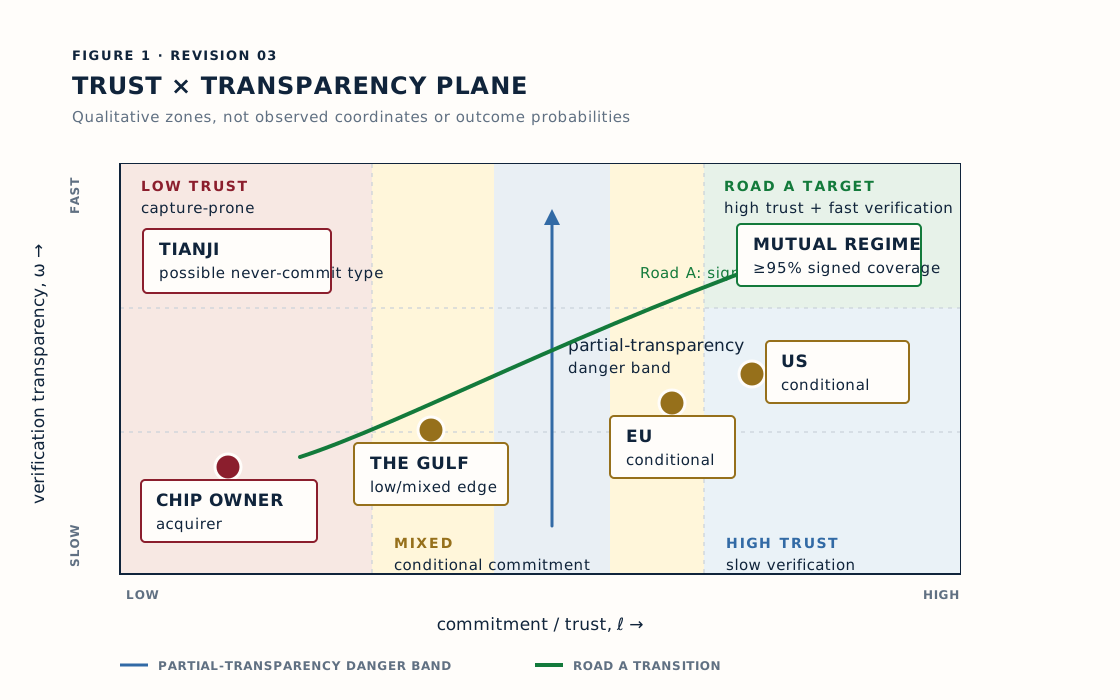
Capture is not presumed. The scenario places named actor classes on a qualitative trust-and-transparency plane and makes Road A depend on an observable verification regime rather than on institutional posture.

Qualitative trust and transparency plane. A chip owner and Tianji sit in the low-trust area. Gulf capital is on the low-to-mixed edge. The EU and United States are conditional mixed-to-high trust actors. Road A requires a signed mutual-verification regime in the high-trust, fast-verification zone.
Figure 1. Qualitative actor-zone map, not measured coordinates and not outcome probabilities. The blue vertical path marks the partial-transparency danger band. Road A requires a move past that band through one deployed, signed verification regime, not increasingly frequent periodic audits.
01 · What ω measures

Partial transparency is a danger zone

ℓ denotes qualitative trust or commitment. ω denotes the verification surface: complete signed placement receipts, receipt-publication latency, independently reproducible audit coverage, and the defined response to a confirmed deviation. An open specification establishes provenance; it does not alone establish a neutral objective or a credible response.

Road A requirement: move ω past the danger band in one deployment. Signed vendor descriptions, complete public receipts, rapid independent audit, and a precommitted telemetry response must arrive together. A partially visible layer is worse than a fully opaque one for this mechanism because it can create confidence without providing a complete basis for detection.

02 · L* as a condition

A detectable tilt must be unprofitable

An acquirer can gain from a placement-level tilt until it is detected. Neutrality survives only when the discounted gain during the verified detection lag is smaller than the loss caused by the telemetry trigger. This is a condition on one detectable behavior, not proof of objective neutrality.

L* = (1/r) ln(1 + Δ/g)

Assumptions: g is the disclosed gain from a detected placement tilt, Δ is the permanent loss after the committed trigger, and r is the disclosed discount rate. Lplacement is the p90 elapsed time from signed receipt generation to a public, reproducible independent-audit finding. Road A target: Lplacement < 72 hours at p90, reported quarterly, with L* disclosed from the stated g, Δ, and r assumptions. Signed vendor descriptions shrink this lag by making the audited object deterministic at generation rather than reconstructing it after a dispute.

Road A design requirements

A verification regime, not a promise

  1. Signed descriptions and complete receipts. Each eligible placement carries the signed vendor description, allocation-rule version, signer, and timestamp.
  2. Independent, reproducible audit. The public record includes the audit frame, exclusions, missing-receipt rate, determination time, finding status, and p90 receipt-to-finding lag.
  3. Precommitted telemetry trigger. Covered vendors publish a contribution baseline and a covenant defining withdrawal or other permanent loss after a confirmed tilt.
  4. Separate objective-level governance. Receipt verification tests a placement-level claim. It cannot alone identify an undisclosed selection objective.
03 · Tianji and trust

A possible never-commit type, not a measured fact

Tianji is a scenario composite. From the Western observer's perspective, it is modeled as a possible never-commit type until reciprocal, independently verified behavior says otherwise. The 0.12 Tianji branch and 0.28 race branch are interpretive priors on qualitative trust. They are neither actor coordinates nor frequency estimates.

Pr(race forever | both rational) ≤ (ℓ̄ / ℓ)2

Within the cited two-player high-trust analogy, the ceiling is 25% at ℓ = 2ℓ̄ and 11% at ℓ = 3ℓ̄. This is a ceiling inside the analogy, not a probability forecast for a multi-actor compute market.

04 · Wargames as calibration

Publish the denominator before the story

Wargames calibrate qualitative zones, not probabilities. The preregistered record defines commitment, defection, placement-level tilt, telemetry contribution, adoption, acquisition bid, role assignment, and event order. Two independent coders report agreement, disputes, missing observations, role imbalance, and uncertainty.

The release reports telemetry contributed per eligible turn, turns to open-standard commitment, adoption share, financier pole, acquisition-bid share, and receipt coverage. It does not infer numerical ℓ, numerical ω, or a public outcome probability.

Observable falsifiers

Four ways the mechanism can fail

01

Configuration Tax. The direct, within-architecture Configuration Tax falls below 30% on an eligible, published heterogeneous fleet of at least 500 distinct architectures by end-2027.

02

Verification coverage. A mutual verification regime reaches at least 95% signed-receipt coverage of eligible placements and sustains independently reproducible audits for four consecutive quarters.

03

L* service level. The quarterly p90 Lplacement from signed receipt generation to public reproducible finding exceeds 72 hours after Road A claims a production verification regime, or the disclosed L* condition no longer holds.

06

Telemetry trigger. A chip owner acquires a neutral layer and, within four quarters, third-party contributor count and normalized contribution volume do not decline from disclosed pre-close baselines.

Each test names a mechanism, not the entire forecast. Its architecture register, receipt record, audit frame, or contributor baseline must be public for the result to count.

Evidence tiers and version control
  1. Refereed foundations. Fudenberg, Gilbert, Stiglitz and Tirole (1983); Harris and Vickers (1985); Harris and Vickers (1987); and Kreps and Wilson (1982) support the generic preemption, time-moat, race, and imperfect-information framing.
  2. Unrefereed v1 working papers. Fudenberg and Koh, Racing to Ruin, arXiv:2607.27638v1, 30 July 2026, and Cooperating against Catastrophe, arXiv:2609.28291v1, 23 September 2026. They motivate the qualitative trust, monitoring, and lag structure, not numerical estimates for Compute 2030 actors.
  3. Scenario inputs. Testbed measurements, interviews, and wargame records remain [method] or [judgment] until their protocol, coding, uncertainty, and exclusions are public.
TIP: PRESS J / K TO ADVANCE OR RETREAT SECTIONS
Part IIIRoad A: Heterogeneous Equilibrium

Owned by no one

2029ROAD A - OPEN PROTOCOLS
FLEET COORDINATION
MANUALAUTONOMOUS
Supervised autonomy (ACP live)
CAPABILITIES
⬡PRF
◈SIM
⊞PAR
⊛CTL
⊕GEN
◉AUT
SUBSTRATE OWNERSHIP
Neutral (ACP governed) 48%
NVIDIA / CUDA 28%
Sovereign (Tianji, EU) 14%
Other merchant 10%
LABOR VS VARIETY
~10,500 specialists / ~8,000 architectures (ACP absorbs gap)
SUBSTRATE
Configuration Tax~12% (ACP fleet)
Utilization~61% (ACP fleet)
Coverage48%
GovernanceACP ratified
WORLD
Strandedfalling
Capex~$1.3T/yr
GovernanceFORMING
CrossoverPASSED
CONFIGURATION TAX TRAJECTORY
The Architecture Coordination Protocol ratified. No single owner emerges.

Open Protocols

The Architecture Coordination Protocol is ratified with a signed verification regime. No single owner emerges. The substrate becomes infrastructure because the governance window produces a testable commons rather than an unverified posture.

The ACP ratification in 2029 is not a dramatic event. It is a standards body vote, attended by representatives of forty-seven organizations, producing a document that most of the industry has not read. But the standard is not treated as self-executing. The ACP establishes the substrate as a commons only alongside signed descriptions, complete placement receipts, independent audit coverage, and a precommitted telemetry trigger. Any substrate model can implement the standard and any architecture can expose it, while observable placement-level deviations can be investigated against a public record. The vote is not unanimous - the incumbent abstains, and Tianji does not participate - but it is sufficient. The governance test begins at ratification; it does not end there.

General Diffusion's HPM-1 and CWM-1 are reference components of the ACP stack. It covers forty-eight percent of the world's AI fleet by the end of 2029, and on the ACP fleet the Configuration Tax has fallen to twelve percent. The improvement is not uniform - the newest and strangest architectures still carry higher configuration losses - but the trajectory is clear and the direction is irreversible. The substrate is working.

The incumbent's proprietary substrate covers a further twenty-eight percent of the fleet, primarily on its own silicon. The incumbent has not adopted the ACP standard, and its substrate is not interoperable with the ACP fleet. This is a strategic choice, not a technical constraint, and it is a choice that is becoming more expensive as the ACP fleet grows and the network effects of interoperability compound. The incumbent is running a proprietary substrate on a shrinking share of the fleet, and the economics of that position are deteriorating.

Tianji covers fourteen percent of the sovereign fleet. The Tianji substrate is not ACP-compatible, but it is capable enough to make the domestic fleet usable, and the bilateral export agreements are expanding. The sovereign track is a parallel track, and it is not converging with the ACP track. The world's compute is beginning to bifurcate along governance lines.

Notes
  1. a1ACP ratification: forty-seven organizations, 2029. Reference implementation: HPM-1/CWM-1 (General Diffusion). Coverage on ACP fleet: 48 percent by end of 2029. Configuration Tax on ACP fleet: ~12 percent. [projected]
2030ROAD A - THE COMMONS
FLEET COORDINATION
MANUALAUTONOMOUS
Broad autonomy (open standard)
CAPABILITIES
⬡PRF
◈SIM
⊞PAR
⊛CTL
⊕GEN
◉AUT
SUBSTRATE OWNERSHIP
Neutral (ACP governed) 65%
NVIDIA / CUDA 18%
Sovereign (Tianji, EU) 12%
Other merchant 5%
LABOR VS VARIETY
~11,000 specialists / ~20,000 architectures (ACP covers fleet)
SUBSTRATE
Configuration Tax~8% (ACP fleet)
Utilization~72% (ACP fleet)
Coverage65%
GovernanceACP operational
WORLD
Stranded~$0.8T/yr (falling)
Capex~$1.5T/yr
GovernanceESTABLISHED
CrossoverPASSED
CONFIGURATION TAX TRAJECTORY
The substrate is a commons. The abundance is available to anyone who connects.

The Commons

The substrate is a commons. The architecture explosion is absorbed, not stopped. The compute abundance is available to anyone who connects.

By 2030, the ACP fleet covers sixty-five percent of the world's AI compute. The Configuration Tax on the ACP fleet has fallen to eight percent. The crossover has passed: the architecture count has outrun the specialist pool, and the fleet operators who are not running a substrate model cannot keep their fleets usable. But on the ACP fleet, the crossover has been absorbed. The substrate is doing the work the specialists cannot do, and it is doing it for everyone who connects to the standard.

The compute abundance is not equally distributed. The ACP fleet is concentrated in the hyperscalers and the large enterprises that adopted early. The long tail of smaller operators is still on legacy toolchains, and the Configuration Tax on that tail is still near the 2025 baseline. But the tail is shrinking. The economics of adoption are now overwhelming, and the ACP standard is accessible to any operator who wants it. The abundance is a commons; the question is how fast it reaches everyone.

The incumbent has begun a quiet negotiation with the ACP standards body. The proprietary substrate is losing share, and the network effects of the ACP fleet are compounding in ways that the incumbent's distribution advantage cannot offset. The negotiation is about the terms on which the incumbent's substrate can become ACP-compatible. The terms are not yet agreed, but the direction is clear: the incumbent is moving toward the standard, not away from it.

Tianji is not moving toward the standard. The sovereign track is widening. The world's compute is bifurcated: an ACP commons covering the Western fleet, and a sovereign substrate covering the Tianji-aligned fleet. The bifurcation is stable for now, because the two fleets are not deeply interdependent. Whether it remains stable is the question that will define the 2030s.

Notes
  1. a2ACP fleet coverage: 65 percent by 2030. Configuration Tax on ACP fleet: ~8 percent. Crossover passed; substrate absorbs the gap. [projected]
2031-2032ROAD A - EQUILIBRIUM
FLEET COORDINATION
MANUALAUTONOMOUS
Full autonomy (governed)
CAPABILITIES
⬡PRF
◈SIM
⊞PAR
⊛CTL
⊕GEN
◉AUT
SUBSTRATE OWNERSHIP
Neutral (ACP governed) 74%
NVIDIA / CUDA 12%
Sovereign (Tianji, EU) 10%
Other merchant 4%
LABOR VS VARIETY
~12,000 specialists / ~50,000 architectures (ACP covers fleet)
SUBSTRATE
Configuration Tax<5% (ACP fleet)
Utilization>80% (ACP fleet)
Coverage74%
GovernanceACP mature
WORLD
Strandedminimal
Capex~$1.8T/yr
GovernanceSTABLE
CrossoverPASSED
CONFIGURATION TAX TRAJECTORY
Heterogeneous equilibrium. The architecture explosion is absorbed, not stopped.

Equilibrium

Heterogeneous equilibrium. The architecture explosion is absorbed, not stopped. The compute abundance is a commons, and the commons is governed.

The ACP fleet covers seventy-four percent of the world's AI compute by 2032. The Configuration Tax on the ACP fleet has fallen below five percent. The architecture count has reached fifty thousand, and the ACP standard is absorbing the variety without human intervention at scale. The crossover has been passed and the crisis has been resolved, not by stopping the architecture explosion but by building the substrate that can absorb it.

The incumbent completes its ACP compatibility transition in 2031. The proprietary substrate is retired; the incumbent's silicon now runs on the ACP standard. The transition is not painless - the incumbent loses the competitive advantage it had on its own silicon - but it is rational, because the alternative is to run a proprietary substrate on a shrinking share of the fleet while the ACP fleet's network effects compound. The incumbent is now a contributor to the ACP standard, not a competitor to it.

The governance of the ACP standard is the new contest. The standards body that ratified the ACP in 2029 is now a significant institution: it controls the evolution of the standard that governs sixty-five percent of the world's AI compute. The contest is not about ownership - the ACP is an open standard, and no single actor owns it - but about influence: who shapes the standard's evolution, who sits on the technical committees, who has the resources to contribute the most to the reference implementation. General Diffusion is the largest contributor, but it is not the only one, and the governance structure is designed to prevent any single actor from controlling the standard's direction.

The sovereign bifurcation persists. Tianji covers twenty percent of the world's AI compute, and the Tianji substrate is not ACP-compatible. The bifurcation is a source of friction - operators who need to run workloads on both fleets face interoperability costs - but it is not a crisis. The two fleets are parallel tracks, and the parallel tracks are stable.

Notes
  1. a3ACP fleet coverage: 74 percent by 2032. Configuration Tax on ACP fleet: <5 percent. Architecture count: ~50,000. [projected]
2033-2036ROAD A - ABUNDANCE
FLEET COORDINATION
MANUALAUTONOMOUS
Full autonomy (open)
CAPABILITIES
⬡PRF
◈SIM
⊞PAR
⊛CTL
⊕GEN
◉AUT
SUBSTRATE OWNERSHIP
Neutral (ACP governed) 82%
NVIDIA / CUDA 8%
Sovereign (Tianji, EU) 7%
Other merchant 3%
LABOR VS VARIETY
~15,000 specialists / ~200,000 architectures (ACP covers fleet)
SUBSTRATE
Configuration Tax<3% (ACP fleet)
Utilization>85% (ACP fleet)
Coverage82%
GovernanceACP global
WORLD
Strandednegligible
Capex~$2.2T/yr
GovernanceGLOBAL
CrossoverPASSED
CONFIGURATION TAX TRAJECTORY
The compute abundance is a commons. No single actor writes the rules.

Abundance

The compute abundance is a commons. The Configuration Tax is negligible on the ACP fleet. The architecture explosion continues, and the substrate absorbs it.

The ACP fleet covers eighty-two percent of the world's AI compute by 2036. The Configuration Tax on the ACP fleet is below three percent. The architecture count has reached two hundred thousand, and the ACP standard is absorbing the variety at scale. The substrate is doing what it was built to do: making the architecture explosion usable without requiring a human specialist for every new chip.

The compute abundance is real, and it is broadly accessible. The long tail of smaller operators that was still on legacy toolchains in 2030 has largely migrated to the ACP standard. The migration was driven by economics: the cost of running a legacy toolchain on a new architecture is now prohibitive, because the architecture count is so high that the legacy toolchain cannot keep up. The ACP standard is the only viable path for any operator who wants to run a heterogeneous fleet.

The sovereign bifurcation has partially resolved. Tianji has begun a quiet process of ACP compatibility for a subset of its architectures - the ones that are used in joint ventures with Western operators. The full Tianji fleet is not ACP-compatible, and the Tianji substrate is not retired, but the bifurcation is narrowing at the edges. The world's compute is not unified, but it is more interoperable than it was in 2030.

The question of who governs the ACP standard is settled, not by a single actor winning the contest, but by the governance structure maturing into something that no single actor can control. The technical committees are large and diverse. The reference implementation is maintained by a consortium. The standard evolves through a process that is slow and contentious and occasionally frustrating, which is exactly what a governance structure for critical infrastructure should be.

Notes
  1. a4ACP fleet coverage: 82 percent by 2036. Configuration Tax on ACP fleet: <3 percent. Architecture count: ~200,000. [projected]
2037-2040ROAD A - OWNED BY NO ONE
FLEET COORDINATION
MANUALAUTONOMOUS
Full autonomy (open standard)
CAPABILITIES
⬡PRF
◈SIM
⊞PAR
⊛CTL
⊕GEN
◉AUT
SUBSTRATE OWNERSHIP
Neutral (ACP governed) 88%
NVIDIA / CUDA 5%
Sovereign (Tianji, EU) 5%
Other merchant 2%
LABOR VS VARIETY
~18,000 specialists / ~1,000,000 architectures (ACP covers fleet)
SUBSTRATE
Configuration Tax<2% (ACP fleet)
Utilization>90% (ACP fleet)
Coverage88%
GovernanceACP universal
WORLD
Strandednegligible
Capex~$3T/yr
GovernanceUNIVERSAL
CrossoverPASSED
CONFIGURATION TAX TRAJECTORY
The semiconductor revolution, exceeded. Owned by no one.

Owned by No One

The semiconductor revolution, exceeded. The compute abundance is a commons, owned by no one, available to anyone who connects.

By 2040, the ACP fleet covers eighty-eight percent of the world's AI compute. The Configuration Tax on the ACP fleet is below two percent. The architecture count has reached one million. The substrate is absorbing the variety at a scale that would have been unimaginable in 2025, when the crisis was first measured and the crossover was first estimated.

The impact of the substrate on the world's compute has exceeded the impact of the semiconductor revolution itself, as the prediction line on the cover of this report stated. The semiconductor revolution doubled the performance of compute every two years for fifty years. The substrate revolution has made the compute that already exists usable, which is a different kind of improvement but a larger one: the gap between what the world's compute can do and what it actually delivers has fallen from 57.3 percent to below two percent, and the compute that was already built is now delivering near its rated capability.

The world in which this happened is not a world without competition. The ACP standard is contested. The technical committees argue. The reference implementation has bugs. The governance structure is imperfect. But the substrate is a commons, and the commons is governed, and the governance is plural. No single actor writes the rules for how the world's compute is governed. The rules are written by the standards body, which is large and diverse and slow and contentious, which is exactly what a governance structure for critical infrastructure should be.

This is Road A. It is not a utopia. It is a world in which the compute abundance is available to anyone who connects, and in which the rules for how that abundance is governed are written by many rather than one. The difference between this world and Road B is not the technology. It is the window, and what was built inside it.

Notes
  1. a5ACP fleet coverage: 88 percent by 2040. Configuration Tax on ACP fleet: <2 percent. Architecture count: ~1,000,000. Impact exceeds the semiconductor revolution. [projected]
Part IVRoad B: Substrate Capture

Owned by one

2029ROAD B - THE ACQUISITION
FLEET COORDINATION
MANUALAUTONOMOUS
Supervised autonomy (capture begins)
CAPABILITIES
⬡PRF
◈SIM
⊞PAR
⊛CTL
⊕GEN
◉AUT
SUBSTRATE OWNERSHIP
Incumbent (acquiring) 52%
Sovereign (Tianji) 18%
Other merchant 18%
Neutral (shrinking) 12%
LABOR VS VARIETY
~10,500 specialists / ~8,000 architectures (capture accelerates)
SUBSTRATE
Configuration Tax~12% (owner's fleet)
Utilization~61% (owner's fleet)
Coverage52%
GovernanceCONTESTED
WORLD
Strandedfalling (owner)
Capex~$1.3T/yr
GovernanceCONTESTED
CrossoverPASSED
CONFIGURATION TAX TRAJECTORY
The acquisition closes. The substrate begins its transition from tool to toll.

The Acquisition

The acquisition closes. The substrate begins its transition from tool to toll. The window for governance has not closed yet, but it is closing faster than the governance process can move.

The acquisition closes in 2029. The acquiring entity - a silicon-owning incumbent, by a route that the scenario does not specify because the route is less important than the destination - takes control of General Diffusion and its HPM-1 and CWM-1 substrate stack. The acquisition is structured as a technology acquisition, not a talent acquisition, and the terms include a non-compete that prevents the HPM-1 team from building a competing substrate for five years. The ACP standard process, which was moving toward ratification, stalls: the largest contributor to the reference implementation is now owned by an actor with a structural interest in the standard not being ratified.

The acquisition is legal. It is reviewed by the relevant competition authorities and approved, with conditions that are insufficient to prevent the outcome. The conditions require the acquirer to license the HPM-1 technology on reasonable and non-discriminatory terms, but the definition of reasonable is contested, and the licensing terms that emerge from the contestation are not the terms that would have allowed a neutral commons to form. The substrate is captured before the standard is ratified, and the standard is not ratified after the capture.

The acquisition creates the incentive for a placement-level tilt, but it does not make every governance outcome automatic. The tilt is unprofitable only when the public verification lag stays below its stated threshold and the telemetry trigger can impose a permanent loss. In Road B, the receipt regime is incomplete, the trigger is weak or absent, and the ownership conflict remains outside independent review.

The captured substrate covers fifty-two percent of the world's AI fleet by the end of 2029. On the owner's fleet, the Configuration Tax has fallen to twelve percent. On the non-owner's fleet, the Configuration Tax is still near the 2025 baseline, because the licensing terms do not make the substrate accessible to competitors at the price that would drive adoption. The difference between the two fleets is not physics. It is permission.

Notes
  1. b1The acquisition route is deliberately composite: a silicon-owning incumbent by acquisition, or a sovereign reaching lock-in first. The route is less important than the destination. [thesis / scenario]
2030ROAD B - LOCK-IN
FLEET COORDINATION
MANUALAUTONOMOUS
Broad autonomy (owner-controlled)
CAPABILITIES
⬡PRF
◈SIM
⊞PAR
⊛CTL
⊕GEN
◉AUT
SUBSTRATE OWNERSHIP
Captured (owner) 62%
Sovereign (Tianji) 22%
Other merchant 10%
Neutral (residual) 6%
LABOR VS VARIETY
~11,000 specialists / ~20,000 architectures (owner controls gap)
SUBSTRATE
Configuration Tax~8% (owner's customers)
Utilization~72% (owner's fleet)
Coverage62%
GovernanceCAPTURED
WORLD
Strandedfalling (owner only)
Capex~$1.5T/yr
GovernanceCAPTURED
CrossoverPASSED
CONFIGURATION TAX TRAJECTORY
Lock-in complete. The difference between the two roads is now permission, not physics.

Lock-In

Lock-in is complete. The difference between the two roads is now permission, not physics. The substrate is a competitive weapon, not an infrastructure layer.

By 2030, the captured substrate covers sixty-two percent of the world's AI fleet. The crossover has arrived: the architecture count has outrun the specialist pool, and the fleet operators who are not running a substrate model cannot keep their fleets usable. But the substrate that can solve the crossover is owned by one actor, and that actor is using the substrate as a competitive weapon rather than an infrastructure layer.

The Configuration Tax on the owner's customers' fleets has fallen to eight percent. The Configuration Tax on the non-owner's fleets is still near 57 percent. The gap between the two is not a technical gap; it is a permission gap. The physics are the same. The substrate works the same way. The difference is who is allowed to use it at what price.

The private telemetry flywheel is running. Every execution trace from the owner's fleet is feeding back into the substrate model, improving its performance on the owner's silicon and widening the gap between the owner's fleet and everyone else's. The flywheel is not a conspiracy; it is a product decision. The owner is building the best possible substrate for its own fleet, and the best possible substrate for its own fleet is one that is trained on its own fleet's execution traces. The gap widens automatically, without anyone deciding to widen it.

The compliance moat is forming. The owner is beginning to require that operators who want access to the substrate at favorable terms use the owner's silicon. The requirement is not stated explicitly; it is embedded in the pricing structure. Operators who use the owner's silicon get the substrate at a price that makes adoption economically compelling. Operators who use other silicon get the substrate at a price that makes adoption economically marginal. The moat is not a wall; it is a gradient, and the gradient is steep.

Notes
  1. b2Configuration Tax on owner's customers' fleets: ~8 percent by 2030. Configuration Tax on non-owner's fleets: still near 57.3 percent. The difference is permission, not physics. [projected]
2031-2032ROAD B - THE MOAT
FLEET COORDINATION
MANUALAUTONOMOUS
Full autonomy (private telemetry)
CAPABILITIES
⬡PRF
◈SIM
⊞PAR
⊛CTL
⊕GEN
◉AUT
SUBSTRATE OWNERSHIP
Captured (owner) 70%
Sovereign (Tianji) 20%
Other merchant 7%
Neutral (residual) 3%
LABOR VS VARIETY
~12,000 specialists / ~50,000 architectures (owner controls gap)
SUBSTRATE
Configuration Tax<5% (owner's customers)
Utilization>80% (owner's fleet)
Coverage70%
GovernanceMONOPOLY
WORLD
Strandedminimal (owner)
Capex~$1.8T/yr
GovernanceMONOPOLY
CrossoverPASSED
CONFIGURATION TAX TRAJECTORY
The telemetry flywheel widens the moat. Competitors run near the old gap.

The Moat

The telemetry flywheel widens the moat. Competitors run near the old gap. The substrate is a toll road, and the toll is rising.

The captured substrate covers seventy percent of the world's AI fleet by 2032. The telemetry flywheel has been running for three years, and its effects are compounding. The owner's substrate is now materially better on the owner's silicon than any competitor's substrate, because it has been trained on three years of execution traces from the largest fleet in the world. The gap between the owner's fleet and everyone else's is wider in 2032 than it was in 2030, and it is widening faster.

The competitors are not standing still. Several large operators have begun building their own substrate models, trained on their own execution traces. The models are capable enough to reduce the Configuration Tax on their own fleets, but they are not capable enough to close the gap with the owner's substrate, because they do not have the owner's scale of training data. The telemetry flywheel is a structural advantage that cannot be overcome by effort alone; it can only be overcome by scale, and the owner has the scale.

The compliance moat is now explicit. The owner has published a tiered pricing structure for the substrate. Tier 1, available to operators who use the owner's silicon exclusively, provides the substrate at a price that makes adoption economically compelling. Tier 2, available to operators who use a mix of silicon, provides the substrate at a price that makes adoption economically marginal. Tier 3, available to operators who use no owner's silicon, provides the substrate at a price that makes adoption economically irrational. The tiers are not stated as a competitive strategy; they are stated as a cost-recovery mechanism. The effect is the same.

Notes
  1. b3Captured substrate coverage: 70 percent by 2032. Telemetry flywheel compounding. Tiered pricing structure published. [projected]
2033-2036ROAD B - THE TOLL
FLEET COORDINATION
MANUALAUTONOMOUS
Full autonomy (compliance moat)
CAPABILITIES
⬡PRF
◈SIM
⊞PAR
⊛CTL
⊕GEN
◉AUT
SUBSTRATE OWNERSHIP
Captured (owner) 76%
Sovereign (Tianji) 18%
Other merchant 4%
Neutral (residual) 2%
LABOR VS VARIETY
~15,000 specialists / ~200,000 architectures (owner controls gap)
SUBSTRATE
Configuration Tax<3% (owner's customers)
Utilization>85% (owner's fleet)
Coverage76%
GovernanceMONOPOLY
WORLD
Strandednegligible (owner)
Capex~$2.2T/yr
GovernanceMONOPOLY
CrossoverPASSED
CONFIGURATION TAX TRAJECTORY
The substrate is a toll road. The abundance exists; access is the product.

The Toll

The substrate is a toll road. The abundance exists; access is the product. The compute abundance is available to anyone the owner permits.

The captured substrate covers seventy-six percent of the world's AI fleet by 2036. The Configuration Tax on the owner's customers' fleets is below three percent. The Configuration Tax on the non-owner's fleets is still near the 2025 baseline, because the licensing terms have not changed in ways that would drive adoption. The gap between the two fleets is the largest it has ever been, and it is stable: the owner has no incentive to close it, and the non-owner's fleets have no path to close it without the owner's permission.

The compute abundance is real. The substrate works. The architecture explosion has been absorbed, on the owner's fleet, at a scale that would have been unimaginable in 2025. The abundance exists. But the abundance is not a commons; it is a product. Access to the abundance is the product that the owner sells, and the price of access is set by the owner, and the price is set to maximize the owner's revenue, not to maximize the world's compute utilization.

The sovereign bifurcation has deepened. Tianji covers eighteen percent of the world's AI compute, and the Tianji substrate is not compatible with the owner's substrate. The world's compute is bifurcated between the owner's fleet and the Tianji fleet, with a small residual of operators running legacy toolchains or proprietary substrates. The bifurcation is not stable in the long run - the two fleets are increasingly interdependent, and the interoperability costs are rising - but it is stable enough in the medium term that neither the owner nor Tianji has an incentive to resolve it.

Notes
  1. b4Captured substrate coverage: 76 percent by 2036. Configuration Tax on owner's customers: <3 percent. Configuration Tax on non-owner's fleets: still near 57.3 percent. [projected]
2037-2040ROAD B - OWNED BY ONE
FLEET COORDINATION
MANUALAUTONOMOUS
Full autonomy (owner-controlled)
CAPABILITIES
⬡PRF
◈SIM
⊞PAR
⊛CTL
⊕GEN
◉AUT
SUBSTRATE OWNERSHIP
Captured (owner) 82%
Sovereign (Tianji) 14%
Other merchant 3%
Neutral (residual) 1%
LABOR VS VARIETY
~18,000 specialists / ~1,000,000 architectures (owner controls gap)
SUBSTRATE
Configuration Tax<2% (owner's customers)
Utilization>90% (owner's fleet)
Coverage82%
GovernanceMONOPOLY
WORLD
Strandednegligible (owner)
Capex~$3T/yr
GovernanceMONOPOLY
CrossoverPASSED
CONFIGURATION TAX TRAJECTORY
The semiconductor revolution, exceeded. Owned by one.

Owned by One

The semiconductor revolution, exceeded. The compute abundance is owned by one. The rules for how the world's compute is governed are written by one actor.

By 2040, the captured substrate covers eighty-two percent of the world's AI compute. The Configuration Tax on the owner's customers' fleets is below two percent. The architecture count has reached one million. The substrate is absorbing the variety at a scale that would have been unimaginable in 2025.

The impact of the substrate on the world's compute has exceeded the impact of the semiconductor revolution itself, as the prediction line on the cover of this report stated. The semiconductor revolution doubled the performance of compute every two years for fifty years. The substrate revolution has made the compute that already exists usable, which is a different kind of improvement but a larger one: the gap between what the world's compute can do and what it actually delivers has fallen from 57.3 percent to below two percent, on the owner's fleet.

The world in which this happened is not a world without compute abundance. The abundance exists, and it is real, and it is large. But the abundance is owned by one actor, and the rules for how that abundance is governed are written by one actor, and the price of access to that abundance is set by one actor. The compute abundance is available to anyone the owner permits, at the price the owner sets, on the terms the owner dictates.

This is Road B. It is not a dystopia. It is a world in which the compute abundance is real and the substrate works and the architecture explosion has been absorbed. But the abundance is owned by one, and the difference between this world and Road A is not the technology. It is the window, and what was not built inside it.

Notes
  1. b5Captured substrate coverage: 82 percent by 2040. Configuration Tax on owner's customers: <2 percent. Architecture count: ~1,000,000. Impact exceeds the semiconductor revolution. [projected]
Select a road above to continue reading.

What is this?

Compute 2030 is a long-form scenario forecast by General Diffusion. It traces the substrate takeoff threshold by threshold, from the measured crisis of 2025 through the closing loop of 2028, and then branches into two distinct endings at the 2030 hinge. Road A describes a signed, testable verification regime. Road B describes capture before that regime becomes operational.

It is not a prediction. It is a structured prior: a concrete, quantitative account of one of many possible futures, designed to be falsified as the window evolves. The named events are illustrative. The mechanisms are the actual claim.

How did we write it?

The forecast is anchored on a measured baseline: the direct Configuration Tax, a 57.3 percent median gap between default and expert-tuned throughput on the same chip and workload. It is not fleet utilization, total waste, or cross-class mismatch. That number is a measurement with a confidence interval.

From that anchor, we extrapolated using hardware roadmap data, fleet utilization curves, NRE cost collapse trajectories, and the architecture count growth rate. We ran wargames with sovereign and hyperscaler customers, conducted expert interviews with compiler engineers and chip architects, and drew on previous forecasting work on the general intelligence for silicon stack. The two endings were derived by varying a single variable: who owns the substrate intelligence layer when it arrives.

Why is it valuable?

The compute governance question will be decided in a narrow window. The forces are already in motion. The first measurements are already in. The window is already closing. A forecast that names the mechanisms, quantifies the anchors, and makes the two endings concrete is more useful than a forecast that hedges across all of them.

The value is not in being right about the dates, which will slip. It is in being right about the shape, which is driven by forces that are already measurable. A reader who finishes this document will have a precise vocabulary for the substrate governance question and a calibrated prior for how it resolves, which is the minimum equipment needed to act on it.

Who are we?

General Diffusion is a company working on compute systems for heterogeneous silicon. We use systems theory, hardware architecture, and policy analysis to define testable conditions around the intelligence layer for silicon. The Good Regulator Theorem motivates the model requirement in this document; it does not establish an institutional outcome.

We do not take positions on which road is preferable. We take positions on which mechanisms are load-bearing, which thresholds are measurable, and which decisions are irreversible. The two endings in this document are not advocacy; they are a structured description of the decision space, offered to the people who will navigate it.

Supplements

Technical Appendices

Supplement A

The Compute Forecast

Architecture explosion, specialist wall, stranded capital

The Architecture Explosion

The architecture count held near fifty for seventy years because two dams held it there: the cost of designing a new processor, and the time it took. In 2026 both dams broke, driven by AI-assisted design tooling that crossed a capability threshold at which a small team could do what previously required a large one.

The NRE for a new architecture fell from approximately $200 million in 2025 to approximately $5 million by 2030. The design cycle compressed from twenty-four months to seven to nine weeks. The architecture count, which was near fifty in 2025, reached one hundred ten by mid-2026, three hundred by end-2026, six hundred by end-2027, three thousand by mid-2028, and twenty thousand by 2030.

The Specialist Wall

The specialist pool that can integrate a genuinely new architecture by hand grows at approximately six percent per year, the historical rate of an adjacent technical discipline. This rate is inelastic to capital because the constraint is training time: three to five years per specialist, with a pipeline that cannot be compressed.

The specialist-to-architecture ratio fell from approximately one-to-one in 2025 to 0.013 in mid-2026, 0.008 in late 2026, 0.005 in 2027, 0.001 in 2028, and 0.00055 at the 2030 crossover. The crossover is the point at which manual fleet coordination fails industry-wide at any salary.

Stranded Capital

The direct Configuration Tax is the within-architecture gap between default and expert-tuned configuration on the same chip and workload. The 57.3 percent does not measure fleet utilization, total waste, or cross-class mismatch. Cross-class mismatch remains an unmeasured hypothesis requiring its own published protocol.

Cumulative stranded capex: approximately $500 billion per year in 2025, rising toward a cumulative $5 trillion by 2030. The waste is invisible because it is distributed and quietly absorbed as a cost of doing business.

Supplement B

HPM-1 and CWM-1: The Model Stack

Architecture, training, and bounded transferability

Architecture

HPM-1 is the Hardware Performance Model. It profiles the relationship between a workload's access pattern, a chip's cache hierarchy, and resulting throughput from execution traces. CWM-1 is the Compute World Model that uses these profiles to rehearse how a fleet will behave before placement.

CRP-1 selects routing and placement. OS-1 controls live execution, with RSP-1 nested as its runtime-safety primitive. A code-generation component supplies verified kernels. These names distinguish system roles; CWM-1 is the only use of the term Compute World Model in this stack.

Training

HPM-1 profiles heterogeneous accelerators; CWM-1 uses those profiles to simulate candidate placements before a workload is committed. The scenario treats the models as bounded by their published evaluation protocol, not as a claim of universal transfer.

Where telemetry is used for Road A verification, the audit surface is the signed description and placement receipt. The telemetry flywheel is not a substitute for the verification regime.

Bounded Transferability

HPM-1 and CWM-1 have bounded transferability. They transfer better to architectures sharing relevant structural features with their published evaluation set, and they transfer poorly to genuinely novel architectures outside that set.

This scenario does not treat additional traces as proof of unconstrained generalization. Any claimed improvement must identify the population, the held-out architectures, the baseline, and the measurement protocol.

Supplement C

ACP and CEP: The Open Protocols

Architecture Coordination Protocol and Compute Exchange Protocol

Architecture Coordination Protocol

The Architecture Coordination Protocol (ACP) is a proposed open standard for substrate interoperability. It defines a common interface layer that allows any substrate model to coordinate any architecture, with no single owner of the standard. Openness is necessary for verification, but it does not alone establish a neutral objective or a credible response to a deviation.

The ACP specification defines three layers: the Architecture Description Layer (ADL), which encodes a chip's structural characteristics in a standard format; the Workload Description Layer (WDL), which encodes a workload's access pattern in a standard format; and the Fleet Coordination Interface Layer (OIL), which defines the API through which a substrate model receives ADL and WDL inputs and returns configuration recommendations. Revision 03 requires signed, versioned descriptions and complete placement receipts as the verification surface for a placement-level claim.

Compute Exchange Protocol

The Compute Exchange Protocol (CEP) is a companion standard to the ACP. Where ACP governs the interface between substrate models and architectures, CEP governs the interface between compute operators and the substrate layer: the protocol through which an operator requests compute capacity, the substrate layer allocates it across a heterogeneous fleet, and the operator receives the result.

CEP is the protocol that makes the substrate layer a market rather than a tool. It enables compute arbitrage: the allocation of workloads to the architectures that can run them most efficiently, across a fleet that may span multiple operators, vendors, and geographies. In Road A, CEP receipts publish the signed description version, allocation-rule version, signer, timestamp, audit-frame status, and independent finding status. This makes Lplacement, the public verification lag, observable rather than inferred.

Supplement D

Governance of the Substrate Layer

Standards, ownership, and the window for action

The Governance Window

The window for governance of the substrate layer is defined by two dates: the date at which the substrate becomes technically capable of absorbing the architecture explosion (approximately 2028-2029), and the date at which the crossover arrives and the substrate becomes infrastructure that operators cannot run without (approximately 2030).

Inside this window, the substrate is valuable but not yet essential. Actors who want to capture it have an incentive to move; actors who want to govern it as a commons have an opportunity to establish the standard, receipt regime, independent audit, and telemetry trigger before capture is complete. After the window, those conditions can be harder to establish, but the outcome is not logically predetermined: it depends on whether a placement-level tilt can be detected within its stated threshold and whether the trigger is credible.

Standards vs. Ownership

The difference between Road A and Road B is not the technology. The substrate arrives either way. The difference is whether the substrate is governed by a standard, verification regime, and trigger covenant that no single actor can quietly evade, or controlled by an owner who governs it as a product.

A standard-governed substrate is a commons only when any actor can implement it, any architecture can expose it, and the rules for its evolution are written by many rather than one. An owner-governed substrate creates a conflict. At the placement level, an ownership tilt is unprofitable only when Lplacement ≤ L*, where L* = (1/r) ln(1 + Δ/g). This derived condition does not establish objective neutrality, which must be governed and audited separately.

Supplement E

Sovereign Compute

Tianji, the EU program, and the bifurcation of the fleet

Tianji

Tianji is the state-directed sovereign compute program in the scenario. It runs a parallel track, training substrate models on domestic silicon and exporting models to sovereign customers through bilateral agreements. In Revision 03 it is also a scenario composite, modeled from the Western observer's perspective as a possible never-commit type until reciprocal, independently verified behavior says otherwise.

The Tianji substrate is not ACP-compatible in the scenario. The sovereign track is a parallel track, and it is not converging with the ACP track. This is a conditional scenario claim, not a numerical placement or an assertion about every Chinese operator. The branch falsifier is observable: reciprocal, independently verified fleet coordination commitments sustained for eight consecutive quarters without a treaty.

The EU Program

The EU program is further behind Tianji and General Diffusion in the scenario. It reaches a decision point in 2028: adopt the ACP standard and contribute to a neutral substrate, or build a sovereign substrate that interoperates with neither. Revision 03 treats the EU as a Road A high-trust, fast-verification target, not a measured fact.

In Road A, the EU adopts ACP in 2029, contributes to the ratification vote and reference implementation, and participates in the signed verification regime. In Road B, the EU builds a sovereign substrate compatible with the owner's substrate on the owner's terms. The zone judgment changes only after the preregistered wargame calibration record is publicly coded and reported.

GENERAL DIFFUSION

Compute 2030 is a scenario forecast. The named events are illustrative rather than load-bearing. The mechanisms are the actual claim.

Published 2026. All figures are projections anchored on measured baselines unless otherwise noted.

TRUNK
2025